Canada is considered the best place for immigrants, students, and workers worldwide. However, understanding IRCC processing times would become a necessity before moving. The processing time defines the time needed for Immigration, Refugees, and Citizenship Canada (IRCC) to process applications, that is, applications for permanent residency (PR), visitor visas, study permits, work permits, and citizenship.
In 2026, IRCC processing times have seen several changes due to increased application volumes, policy changes, and massive backlogs in some immigration categories. Having an idea of the prevailing IRCC processing times for immigration, family sponsorship, or studies will allow you to plan carefully.
This guide will see you through the 2026 IRCC processing time trends, what applicants should expect when initiating their procedures, and whatever else one might wish to know concerning this subject.
What Are IRCC Processing Times?
IRCC processing times refer to the estimated time taken by the Canadian immigration authorities to review and finalize an application. These timelines begin once IRCC receives a complete application and end when a final decision is made.
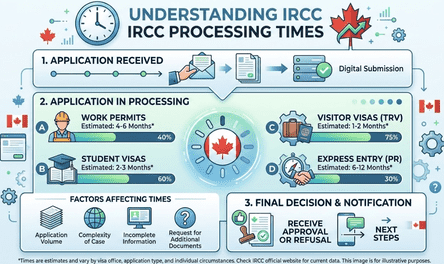
Normally, IRCC-based published processing timelines are drawn against a set of historical data, which shows the time it took to process up to 80% of applications in a particular category. Hence, the actual processing time may vary between applicants based on factors such as:
- The completeness of the application
- Security and background checks
- The country in which the application is being made
- Volume of applications
- Demand for additional documentation
The applicant who understands this system can better manage expectations while waiting for updates on their Canada immigration processing time status.
IRCC Processing Times latest (February 2026)
Given the prevailing circumstances, IRCC has been regularly updating processing times. Below are the latest estimates concerning major immigration categories in 2026.
CITIZENSHIP APPLICATION PROCESSING TIME
The previous year’s delay, which has now lasted through to the present year, can be avoided when new applications are processed through expedited processing
Application processing times
The processing times for Citizenship applications have increased slightly compared to 2026.
Current project timelines are as follows:
- Citizenship grant: About 14 months
- Citizenship certificate: About 11 months
- Relinquishment of citizenship: About 18 months
- Search on Citizenship Records: About 16 months
Delayed processing for most citizenship applications has thus now stretched to more than 300,000 people and can be very long.
Applicants have to ensure that all required documents are submitted so that they are not rejected as a result of any missing documents, thus causing delays.
Permanent Resident Card (PR Card) Processing Times
PR card processing remains one of the fastest services in the Canadian immigration system.
Current processing times:
- A new PR card: Approximately 61 days
- Renewal of PR card: About 30 days
The above dates suggest an improvement in processing in this category as compared with the most recent months.
Family Sponsorship Processing Times
In many respects, some of the highlights thereof were particularly born of the following:
- Spouse sponsorship (within Canada): as of 2026, less than 15 months
- Quebec family sponsorship: up to and beyond 35 months
Delays seem substantial, as tens of thousands of applications have been approved and are pending final certification in probably latent categories.
Economic Immigration Times
In Canada, the economic immigration classes of visas are for skilled workers and businesspersons to get their permanent residency. These programs have emerged even in the Express Entry system and the provincial programs.
The recent IRCC processing times are stated as follows:
- Canadian Experience Class (CEC): about 7 months
- Federal Skilled Worker Program (FSWP): about 7 months
- Express Entry Provincial Nominee Program (PNP): about 7 months
Non-Express Entry Programs:
- PNP (Non-Express Entry): about 13 months
- Quebec Skilled Worker: about 11 months
Programs are currently experiencing extremely long processing times as a result of backlogs. For example, the Start-Up Visa and Self-Employed categories can take anywhere from 10 years to a lifetime.
The importance of selecting the right pathway for immigration is underscored by these delays.
Visitor Visa Processing Times
Visitor visas are probably the most common kind of immigration Canada application. The IRCC visa processing time can vary significantly depending on where you apply.
Typical timelines for visitor visas are as follows:
India: 78 days approximately
United States: around 25 days
Nigeria: 51 days approximately
Pakistan: 58 days approximately
Philippines: 18 days approximately
Applications submitted in-Canada typically take around 21 days.
The stats usually change. So it would be helpful for applicants to check the latest updates.
Super Visa Processing Times
Super Visa lets the parents and grandparents of Canadian citizens or permanent residents stay in Canada for long periods.
Current rough estimates are as follows:
India: about 213 days
United States: about 205 days
Pakistan: about 124 days
Nigeria: about 46 days
We can see that processing time differs significantly from country to country for the application owing to background checks.
IRCC Processing Times for the study permits
Canada has opened its arms to many international students, and the processing time for the study permit is estimated to remain at that relatively stable level.
Typical processing estimates are as follows:
India: around four weeks
United States: about seven weeks
Nigeria: around eight weeks
Pakistan: around seven weeks
The Philippines: about five weeks
Applications lodged in Canada promise to take about eight weeks of processing. Thus, these timeframes help students make their travel plans and academic schedules.
IRCC Processing Times for Work Permits
Work permits are issued to foreign nationals who temporarily come to work in Canada, and in some cases, a work permit serves as a wide-open path to gaining permanent residency.
Typical processing times:
–India: around 8 weeks
-United States: around 10 weeks
-Nigeria: about 9 weeks
Nevertheless, it is possible that some work permits in Canada could be processed over 200 days because of different programs and backlogs.
The fact that Canada has even started particular Industry-specific priority processing services for workers required to fill the gaps in public services like healthcare, agriculture, etc.
IRCC Processing times vary often:
The processing times for the application may change based on the following factors:
- Application Volume
Canada receives millions of immigration applications each year. There may be huge seasonal increases, especially at the beginning of the year, creating backlogs for short durations of time.
- Policy Changes
Changing policies or deciding on immigration targets will decrease resources consumed by some programs.
- Security and Background Checks
Some applications with certain applicants required rigorous background screening, review, and validation of information, driving an increase in the overall processing time.
- Staffing and Resources
Immigration Department staffing levels will influence the speed of their processing a great deal.
- Global Events
Events with an international perspective or geopolitical matters do increase the demand for visas, leading to large-scale population moving towards the visa-issuing authorities.
For instance, international events and related trends in travel have exacerbated the pressure on visa processing in Canada.
The tips to follow to avoid delays by the IRCC are to eliminate delays themselves. This is not something in the realm of an applicant’s control, but measures taken up by the applicants in order to avoid delays are as follows.
Create a complete file with good documentation
Most of the applicants submit incomplete files, which is the number one thing that leads to delays.
Always Review Forms
Make sure you read over the PDFs or the paper forms many times to ensure consistency of information.
Respond promptly to IRCC’s requests
Should the CIC require the documents or biometrics, provide a response period as soon as possible.
Apply well in Advance
Should you desire to encounter management delays, then the plan should be to submit applications well in advance on dates accordingly.
Monitoring IRCC’s Updates
The processing time may change due to the new information on the IRCC content.
“Are the processing times mentioned by the IRCC to be taken as a guarantee?”
They are, therefore, only a guide, as the 80% processing time is still around 20%, thanks to complexity or additional verification requirements that push them past the timeframes.
Applicants should, therefore, take these timeframes with a grain of salt rather than as fixed deadlines.
Result
An understanding of IRCC processing times is vital for those who wish to immigrate, study, work, or visit Canada. The IRCC processing times 2026 vary according to the immigration programs and the country in question.
While the PR card renewals and study permits still remain among the fastest categories, family sponsorship and some economic immigration streams are still for the long haul.
As Canada remains a destination for global talents and students, IRCC may subsequently make adjustments in its system to cater to application volumes and prevent backlogs.
For applicants, the best way to go about it will be submit a complete application, keep abreast of the announcements of IRCC, and plan by processing the approximately the most current processing times with the highest flexibility.