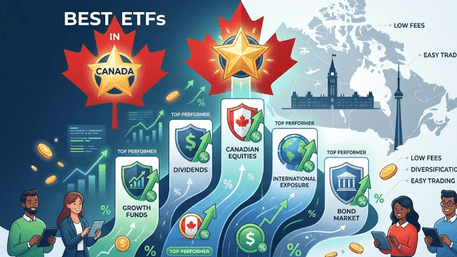
One of the most preferred investment means for Canadians to grow wealth is to buy exchange-traded funds (ETFs). ETFs offer really good opportunities to invest in the stock market without the uncertainties of selecting individual stocks. This makes them more attractive: Low fees, diversification, and flexibility. This piece will cover the Best ETFs in Canada, what makes them appealing, and how to select an ETF to attain your investment goals.
What is an ETF and why is it Popular in Canada?
An exchange-traded fund, or ETF, is a collective investment scheme that trades on stock markets like an ordinary stock. Typically, an ETF replicates either the performance of an index, a commodity, or a basket of assets. The attractiveness of Best ETFs in Canada lies in their three main advantages: diversification, low fees, and liquidity.
The popularity of ETFs in Canada has been the result not only of the low fees but also of other advantages, which have resulted in increased acceptance of this investment vehicle, now ascribed as a mainstream asset for most investors due to these strong virtues.
A key point is the cost advantage: a vast majority of ETFs carry fees far below those of traditional mutual funds.
Exchange-traded funds can accommodate both risk seekers and risk-averse investors because they reflect well-diversified corporations, possess advantageous tax conditions, and are bought by investors through minority brokers- all of which pose benefits to their investors.
Individuals are increasingly moving toward putting their money in ETFs to create a well-balanced investment portfolio. By comprehending the best ETFs in Canada, one may potentially better their investment choices.
How to Evaluate the Best ETFs in Canada
Selecting the best ETFs in Canada involves an assessment of your investment objectives, risk tolerance, and time horizon for investing. In this regard, the following key considerations are relevant:
- Expense Ratio
The expense ratio is an annual fee that the ETF charges each year. Specifically, this fee is standardized as a percentage based on your investment amount. As a result, high fees can eat into your overall returns, reducing the growth of your investment over time. Therefore, low-cost ETFs are generally more desirable for investors who want to maximize returns. In addition, choosing ETFs with lower fees can make a significant difference in long-term wealth accumulation.
- Dividend Yield
Some ETFs pay dividends, and this thus enables a periodic income stream. For Canadian investors seeking passive income, dividend ETF options are a great place to start.
- Exposure
Look for ETFs that cover multiple sectors or surefire regions. Exposure to these different sectors basically guarantees that we can almost check off the box when it comes to protecting the funds from the type of equity relying on investment returns from a single stock.
- Trading
Liquid ETFs tend to trade at or near net asset value, though not always so. Having more liquidity means buying or selling into or out of the ETF without worrying about price impact. Several of the highly liquid ETFs are Canadian-listed.
- Risk tracking
When selecting ETFs, choose those that are most appropriate based on how their long-term and short-term beta clearly reflect the fund’s performance relative to the benchmark investment strategy. Additionally, consider how this alignment may impact your portfolio’s risk and returns over time.

Major ETF Categories in Canada
Canadian ETFs sit in several categories, with each serving a different investment purpose. Understanding these categories will significantly help in selecting the best ETFs for your portfolio.
- Equity ETFs
Equity ETFs allocate funds to the stock market, aiming to replicate the performance of a specific index. Because of their growth potential, they are particularly well-suited for investors with a long-term perspective. Moreover, equity ETFs offer an easy way to gain diversified exposure to multiple stocks without picking them individually.
S&P/TSX 60 ETFs: Track the top 60 companies in Canada
Equity ETFs in general: There lies the exposure abroad to overseas markets such as the U.S., Europe, or even emerging markets.
- Bond ETFs
Bond ETFs invest in government or corporate bonds and are generally less volatile than equity ETFs. They provide stability and income, making them suitable for conservative investors.
- Dividend ETFs
Dividend ETFs focus on high-yield stocks that pay regular dividends. They are excellent for Canadian retirees seeking passive income.
- Sector ETFs
Sector ETFs target specific industries such as technology, energy, or healthcare. Investors confident in a particular sector can benefit from these focused funds.
- Thematic ETFs
Thematic Best ETFs in Canada invest in trends like clean energy, artificial intelligence, or cannabis. They can offer high growth potential but come with a higher risk.
Best ETFs in Canada for 2026
Here are some of the best ETFs in Canada for 2026, selected based on performance, fees, veracity, and range:
- iShares S&P/TSX60 Index ETF (XIU)
- Have just drawn up some notes.
- This sort of material is subject to economic complications.
The following ETFs offer a blend of growth, income, and stability, thus going far beyond and above the rest ETFs in Canada to choose relatively quickly in 2066.
Advantages of Mutual Fund Trading in Canada
Below is a single enumeration of the benefits of investing in ETFs:
- Low Cost: This implies lower fees, as opposed to mutual funds.
- Diversification in No Time: This means that you can spread your risk across several stocks or bonds.
- Moving on a Whim: You can buy or sell ETFs any time within the trading hours.
- Transparency: The ETFs publish their holdings daily, unlike some mutual funds.
- Accessibility: Quite a few ETFs may boast of low minimum investment requirements.
For the Canadians out there who seek wealth creation without spending endless time-making research on individual stocks, ETFs are the ultimate fix.
Guidelines for Ensuring Superior Returns with Canadian ETFs
- Regular Investment: By spreading the investments over time, the investor may reduce the risk associated with market timing.
- Rebalancing Portfolio: One should also attempt to alter the portfolio once in a while to push the momentum toward the targeted allocation.
- One Can Do Well by focusing on Low Costs: Small fee differences can add up over time.
- Also, consider mixing other assets, including Canadian, US, and Global ETFs, not just the ETFs of Canada and the US.
- Placing ETFs in either a TFSA or an RRSP account is normally good for tax reasons.
Frequently asked questions about ETFs in Canada
Q1: Are ETFs safe investments?
Compared to single stocks, ETFs are relatively safer given their diversification. They are, nonetheless, essentially market risk levels.
Q2: Can I invest in ETFs with a small amount of money?
Most of the Canadian brokers allow you to purchase ETFs with as little as $100.
Q3: How are ETFs taxed in Canada?
If you hold sigils of ETFs within a TFSA, they can be grown tax-free. RRSPs just involve tax Deferral for any ETFs. Capital gains and dividend taxes are also a possibility for ETFs held within regular accounts.
Q4: What is the best ETF for a beginner?
Some of the best choices for beginners would be broad market ETFs such as XIU or VCN, since they have broad diversification and the charges are extremely low.
Final Thoughts: Why ETFs Are a Smart Choice for Canadians
The advantage of placing in the best funds in Canada is that one will get a convenient, cost-effective, and diversified approach to one’s investment with an eye on growth, income, or both.
By opting for low fees, broad diversification, and regular investment, Canadian investors can use ETFs to harness their potential to meet their financial goals.
It isn’t just a difficult skill for investing in ETFs, but an absolutely reasonable way for those who wish to possess control over their own financial future. Commence investing in a few diversified broad-market ETFs, broaden these in due course, and watch your wealth grow.