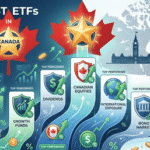
How to make really well-paid transactions in Canada? Having a smart TFSA investing strategy is an almighty financial step to take.
Established in 2009, TFSA operates as a means of giving tax-free earnings to many Canadians. Also, many people consider it to be merely a simple account. However, many would not realize its power to develop wealth.
As a follow-through guide, you will learn:
- What a true TFSA is regarding the topic
- What are the top TFSA investing strategies for 2026 are
- Best ways to make investments inside your TFSA
- What common mistakes to avoid
- Maximize one’s tax-free growth in the Canadian context
- Sound interesting? Here we go then!
What is a TFSA, and what makes it a powerhouse?
The TFSA was basically created as a plan for Canadians who are on the go, either for single folks who may wish to make a few movements by and by.
The main advantage of your TFSA investing strategy lies in the fact that:
- No tax on capital gains
- No tax on dividends
- As a result, every withdrawal remains 100% tax-free.
- Withdrawals do not harm the benefits of the government.
- Contribution room moves forward.
Withdrawals from a TFSA are not considered as earned income, unlike RRSPs; hence, no tax arises. This feature implies the flexibility for you to withdraw at any time without incurring any net effect on your taxable income. This freedom establishes TFSA as one of the greatest arsenal tools of the Canadian investor.
Assuming your savings bank is offering you no more than 1-2% interest, then do you see any growth limited? An arduous investment under a right-fit TFSA investing strategy can remarkably jack up your growth potential for offerings.
Best TFSA Investing Strategy for 2026
How to position your TFSA investment strategy is more a concern of three main factors: age, risk tolerance, and, in the case of many, their investment time.
Now, let’s dig deep into the list of effective strategies that Canadians of the new era are using, step by step, to carry out the best investment in their TFSA.
Long-term ETF Growth Strategy (Best for Most Canadians)
Keep in mind that if you have the kind of foresight to understand a TFSA’s long-term potential in terms of growth, you will be an investment champion, sealing your future. For this very reason, costly ETFs are not on today’s list as yet; rather, we steadfastly believe in keeping them until you are ready to adjust your courses.
Popular all-in-one ETFs include:
- Vanguard All-Equity ETF Portfolio (VEQT)
- iShares Core Equity ETF Portfolio (XEQT)
- The Benefits of Using ETFs in a TFSA
First, ETFs provide diversification across the world. When there’s such a lot of investment across thousands of corporations, your risk extends as well.
The second is that management fees are low. Meaning, this generally ensures an investor gets to keep more of their returns than they would with a mutual fund.
And finally, they are easy to manage; thus, the “systematic investment system” serves as well.
If you are under 45 years of age and looking more towards retirement, all-equity ETFs may be the way to go. Over 20-30 years, the greatest power may arise owing to tax-free compounding.
Dividend TFSA Investing Strategy
Other Canadian investors favor dividend investing. These investors don’t buy ETFs; rather, they invest in solid dividend-paying companies.
Some of the best Canadian dividend companies are:
- Royal Bank of Canada
- Toronto-Dominion Bank
- Enbridge Inc.
What Makes Dividend Stocks Strong in a TFSA
First, dividends grow tax-free. Consequently, your income compiles even faster.
Secondly, reinvestment represents an option that accelerates dividend growth. This clearly magnifies the long-run investing potential.
Passively earning income through dividends is a cinch. So, it makes early retirement a fresh prospect.
After all, if you are dreaming about financial freedom in Canada, a share of a TFSA focused on dividends would guarantee income for a long investment horizon.

TFSA Investing Strategy for Growth Stocks (Higher Risk, Higher Reward)
Alternatively, some investors can choose growth stocks. In fact, these are companies with strong potential for growth, and consequently, they may offer higher long-term returns.
Among rising sectors in 2026 are the following groups:
- There are tenable opportunities in AI to name just a few.
- But can provide a seasoned return on investment in the tech sector
- And reorder healthcare and
It is the best option for such high-growth investments since all capital gains are tax-free. A double in stock value means that 100% of the profits would be left in your hands.
Yet the risk is also quite high, as growth stocks increased characteristic volatility. Hence, the best way to maintain investor returns should be a well-organized, diversified investment portfolio. Balancing long-term goals against short-term risk exposure coming from a portfolio with uncertain volatility is the ultimate best practice.
TFSA Contribution Rules That Every Canadian Needs to Know
Before you start any TFSA investment strategy, you are advised to familiarize yourself with TFSA contribution rules.
Below are some basic points to take home:
- Unused contribution rooms are not lost. They are carried forward
- Withdrawals open new contribution rooms in the subsequent year
- Some penalties are applied for over-contributing
A one per cent penalty, calculated for every month, is levied on the over-contribution. Hence, one should verify before investing.
Once your contribution room is controlled, you can then easily benefit from compounding dollars and, as a result, grow your wealth tax-free over time.
Where to Open a TFSA for Investing in Canada
To begin implementing a suitable TFSA investing strategy, one should first open a self-directed brokerage account and then gradually select the right investments for their goals.
Some of the Canadian platforms to consider include:
- Wealthsimple
- Questrade
- RBC Direct Investing
Each of the platforms comes with guaranteed TFSA-enrolled accounts; moreover, several of them also provide commission-free ETF purchases, making it easier and more cost-effective to invest.
Therefore, look at the fees, trading platforms, and tools available. Choose the one that suits your needs.
TFSA Investing Strategies by Age
Indeed, age is a critical factor in shaping your TFSA investing technique; moreover, it influences the risk level, investment horizon, and overall strategy you should adopt.
- 20s and 30s
Here, the emphasis should be on growth. Because you are young and time is still much in your favor, volatility does not pose that much of an issue. High equities exposure, at 80% or greater, might therefore seem sensible.
- 40s
At this stage, the tilt should gradually shift toward a more even balance. In addition, a mild to moderate risk reduction is just as important as continuing to achieve some growth, and ultimately, both work together to stabilize your portfolio.
- 50s and 60s
At this stage, capital preservation becomes absolutely crucial. Alternatively, if that isn’t sufficient, dividend investing or other low-volatility investments could also prove to be winners.
In the end, consistency trumps perfection in every situation; moreover, by staying consistent, you can gradually achieve better results over time.
Common TFSA Investing Mistakes
Even professionals make mistakes. An ounce of prevention is worth a pound of cure, so here`s how to head off those gaffes.
- Keeping Only Cash
While money preserves capital mostly, it does little to bring inflation down. It limits growth and funding opportunities.
- Overtrading
Buying and selling too often dramatically increases the risk that your money is exposed to. You will also attract the attention of CRA, looking at your excessive trading transactions.
- Ignoring Asset Allocation
Ultimately, investing is risk management. Without proper diversification, your investment portfolio can quickly become extremely vulnerable. Therefore, it’s essential to ensure you invest across a representative number of sectors and regions to reduce risk and enhance stability.
- Over-Contribution
So, here’s the point: penalties get charged every month, so you’d better keep an eye on those limits.
Advanced TFSA Investing Tips for the Pros
If it is strictly about maximizing what you put in, then you might also consider some fairly advanced ideas; additionally, exploring these strategies can help you optimize your TFSA growth more effectively.
- Answer—Dollar-Cost Averaging
Continue to invest in the account every month. It reduces the market-timing risk.
- Reinvest Dividends
Set up DRIP on any equity, if possible. This will compound your profits rapidly.
- Long-Term
If anything, it pays to be patient. Market volatilities, though, ought to provide for those who weather them in the long run.
Building Wealth through Compounding within the TFSA
Here is a simple example.
- Invest $6,500 every year, at an average 7% return. By 30 years you would have compiled hundreds of thousands of dollars.
- And…the beauty of this is you don’t pay any taxes on the gains!
So the earlier you start with your TFSA investing strategy, the better your long-term results would be.
Final Thoughts: Why Every Canadian Needs a TFSA?
So, in conclusion, it’s always really important to develop a well-grounded investment strategy for a TFSA if you want to have tax-free wealth flowing through one of the mutual funds in Canada.
It helps you very well.
- Grow investments without paying capital gains tax
- Generate tax-free passive income
- Maintain retirement flexibility
- Protect purchasing power against inflation
This must be an ongoing and disciplined effort. Invest in your regular deposit method. Stay diversified. Think long-term.
In doing so, your TFSA will become one of your most wonderful wealth-building tools, as you add it to the family of components and borrow against the potential balance of other financial planning tools.