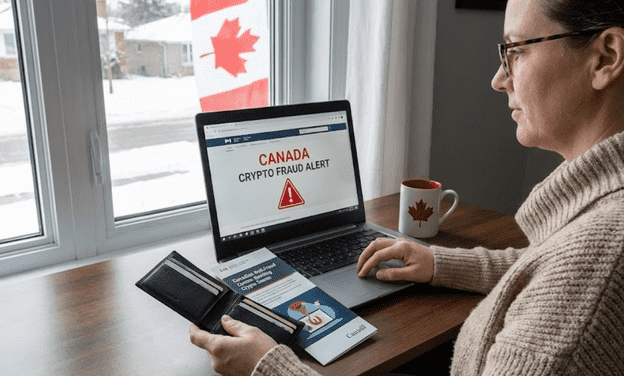
Cryptocurrency has gained wide recognition among Canadians. From Bitcoin to Ethereum and the proliferation of altcoins, many Canadian traders look to digital assets as a form of investment. However, for those who want to stay safe, understanding how to avoid crypto scams in Canada is crucial. As digital assets provide handsome opportunities, there is always a scammer ready to exploit anyone who doesn’t know how to avoid crypto scams in Canada.
In light of this, we are presenting a guide for Canadians to identify and report a crypto scam. Quite a lot of chapters delve deep into suggesting practical measures for protection, red flags to keep an eye on, and wisdom for securing the integrity of your investments.
What Concretises the Danger of Scams in Canada for Currencies?
There is very little monetary regulation in the world of cryptocurrencies when compared with the supreme power of the traditional banking system. The funny thing is, there is room for innovation and the legal types of scams to take place. Regulatory institutions manage national matters in Canada; the Canadian Securities Administrators (CSA) and FINTRAC keep an eye on major financial activities. But it doesn’t mean there aren’t scammers.
That’s why understanding how to prevent crypto scams in Canada is paramount. These scams could see you losing all the money in your position. There are also no means by which to reverse cryptocurrency transactions, quite the opposite of banks. Hence, after access has been granted by the scammer, recovery seems most unlikely.
Step 1: Understanding the Types of Crypto Scams
“Learn how to avoid crypto scams in Canada. First, understand the forms scams tend to take—typical crypto scams in Canada include phishing, fake exchanges, and Ponzi schemes. Moreover, use exchanges with two-factor authentication, digital asset insurance, and FINTRAC compliance. Additionally, storing your cryptocurrency in private wallets is an ideal way to secure your investments, as these wallets are twofold, offering enhanced safety and control:
- Fake Exchanges: Fake websites or platforms claiming to be legitimate Canadian exchanges.
- Phishing Emails/Websites: Bogus emails generated by scammers who pose as real account executives and prompt you to enter your login details.
- Ponzi/Pyramid Scheme: An offer of guaranteed returns usually fed by the investments of newer clients to pay off older ones.
- Fake Giveaways: Promise you “free crypto” in exchange for you paying an initial tiny fee.
- Personation: Cons who pose as celebs, influencers, or crypto experts.
You can significantly reduce the risks of being scammed by being able to spot scammers.

Step 2: Use Regulated Canadian Crypto Exchanges
Using legitimate exchanges in Canada is considered one of the most reliable ways of protecting oneself. They usually abide by strict rules and are subject to state oversight, in contrast to shady sites.
Among the more popular legit sites in Canada are:
- Bitbuy
- Coinsquare
- Kraken Canada
- Newton
Discover how to avoid crypto scams in Canada. First, learn why using exchanges with two-factor authentication, digital asset insurance, and FINTRAC compliance not only protects your investments but also ensures they remain safe and legal. Furthermore, by following these steps, you can confidently navigate the Canadian crypto market.
Step 3: Secure Your Crypto With a Wallet
Learn how to avoid crypto scams in Canada by using exchanges with two-factor authentication, digital asset insurance, and FINTRAC compliance. Moreover, this is an ideal way of storing your cryptocurrency in a private wallet, apart from using Canadian-regulated platforms. These wallets are twofold, offering enhanced security and control over your investments.
- Hot Wallets: These wallets are connected to the internet and are convenient, but they might be less secure.
- Cold Wallets: These are offline hardware wallets, and security is their selling point.
By keeping your large crypto amounts primarily in a cold wallet, you are at a very low risk of losing your crypto when there are scams/ Are shouldering some trauma regarding keys and recovery phrases, never share your private keys or recovery phrases. Just remember, when you let somebody else access your keys, they hence control your finances.
Step 4: “Guaranteed Return” Promises Should Guide You
Danish impostors bait Canadians with a lure of making fast money. If an investment ensures that returns are guaranteed, alluring voices whisper to you that it is an awful scam. The best coins in exchange for cryptocurrency market are mostly volatile and occasionally experience significant up-and-down price fluctuations.
So the evaluation should be based on:
- Research in full depth the team and project involved.
- Look for independent perspectives regarding that.
- Do not base any decisions solely on social media and/or messaging app marketing blitz.
Moreover, this lack of belief forms the hinge; therefore, if one is learning about Canadian financial fraudulence based on Bitcoin, being appropriately cynical allows one to distinguish scams more effectively. Consequently, this approach helps navigate the market in a safer and less risky manner.
Step 5: Protection from Phishing Attacks
Here are some typical ploys that the fraudsters are known to have used in Canada. Phishing attempts generally use falsified emails or websites meant to pass as being from the genuine blockchain companies.
- To protect yourself, always double-check.
- Always check the URL of each website.
- Enable 2FA on all exchange accounts.
- Never click on links that come in emails that you never signed up for.
- Always verify any communication in support of their claim.
By staying informed and keeping your eyes open on the Internet, you can prevent one of the easiest ways scammers employ to get their hands on some of your cryptos.
Step 6: Avoid Sharing Personal or Financial Information
The request made by scammers may even unnecessarily disclose the following sensitive information to you:
- Private keys or recovery phrase
- Bank account information
- Social Insurance Number (SIN)
Remember that genuine traders and platforms will never ask for your private keys. Keeping your personal information safe is a fundamental step in learning how to avoid crypto scams in Canada. Also, a thing worth mentioning is that if a request seems unnecessary or suspicious, it should be queried.
Step 7: Find Information on Canadian Regulations
In this developing environment, wherein Canada presently has regulations to better protect the wise broker, keep yourself updated and head to the next sites.
- Canadian Securities Administrators (CSA)
- Fintrac
- Major Canadian Exchanges
By staying updated, spotting scams will become easier, therefore keeping you in line with the law in Canada. Regulatory awareness is an additional safety net for your investments.
Step 8: Start Small and Spread Out How to Avoid Crypto Scams in Canada
With safeguards, crypto is still a high-risk endeavour:
- Start small with funds you can afford to lose.
- Spread it across several coins and platforms.
- Mingle it with traditional investments.
Embracing the methods allows Canadian investors to walk through the crypto market in a safe fashion, intellectually armoured to deflect the crypto scams of Canada.
Step 9: Use Trusted Resources and Communities How to Avoid Crypto Scams in Canada
Canadians should only accept proven crypto literature to attain some understanding of cryptocurrency evolution:
- Blogs put up officially by cryptocurrency exchanges, where else
- CSA and FINTRAC alerts specifically aimed at investors
- Forums which have been much considered as trustworthy, such as Reddit r/cryptocurrency.
It is advisable to disregard pieces of advice from unknown social media influencers or investment constituencies that solicit advances in capital. If the case is one based on first-hand advice, the risk of falling into bulls**t scams is diminished.
Step 10: Report Suspicious Activity: How to Avoid Crypto Scams in Canada
If you suspect that a fraudster is possibly engaging in scam activities:
- Make an official report via the Canadian Anti-Fraud Centre (CAFC)
- Call your exchange at the earliest for technical assistance
- If applicable, reach the nearest local police
This action serves not only to shield you but also to enable other Canadians to evade such scams.
Closing Thoughts: How to Avoid Crypto Scams in Canada
Crypto is believed to offer some exciting opportunities for Canadians, but the thing to care most about here should be keeping them safe. You can see the risk factor decline significantly when the four-point plan is used: regulated exchanges, safe wallets, staying informed, and keeping that healthy scepticism.
In short:
- Crypto scams can come in different forms.
- Use regulated Canadian exchanges for your transactions.
- Rescue your funds with wallets.
- Watch out for phishing and fake giveaways.
- Abide by Canadian law, keeping a vigilant eye on the suspicious.
Learning how to avoid fraud in the crypto industry in Canada shouldn’t be just about avoiding monetary loss; it’s also about sensible investing and wise decision-making in a constantly changing financial environment.
Canadians can reap the fruit of cryptocurrencies with minimal risks if they can afford all the above, while planning and keeping a vigilant eye.